 orbitrace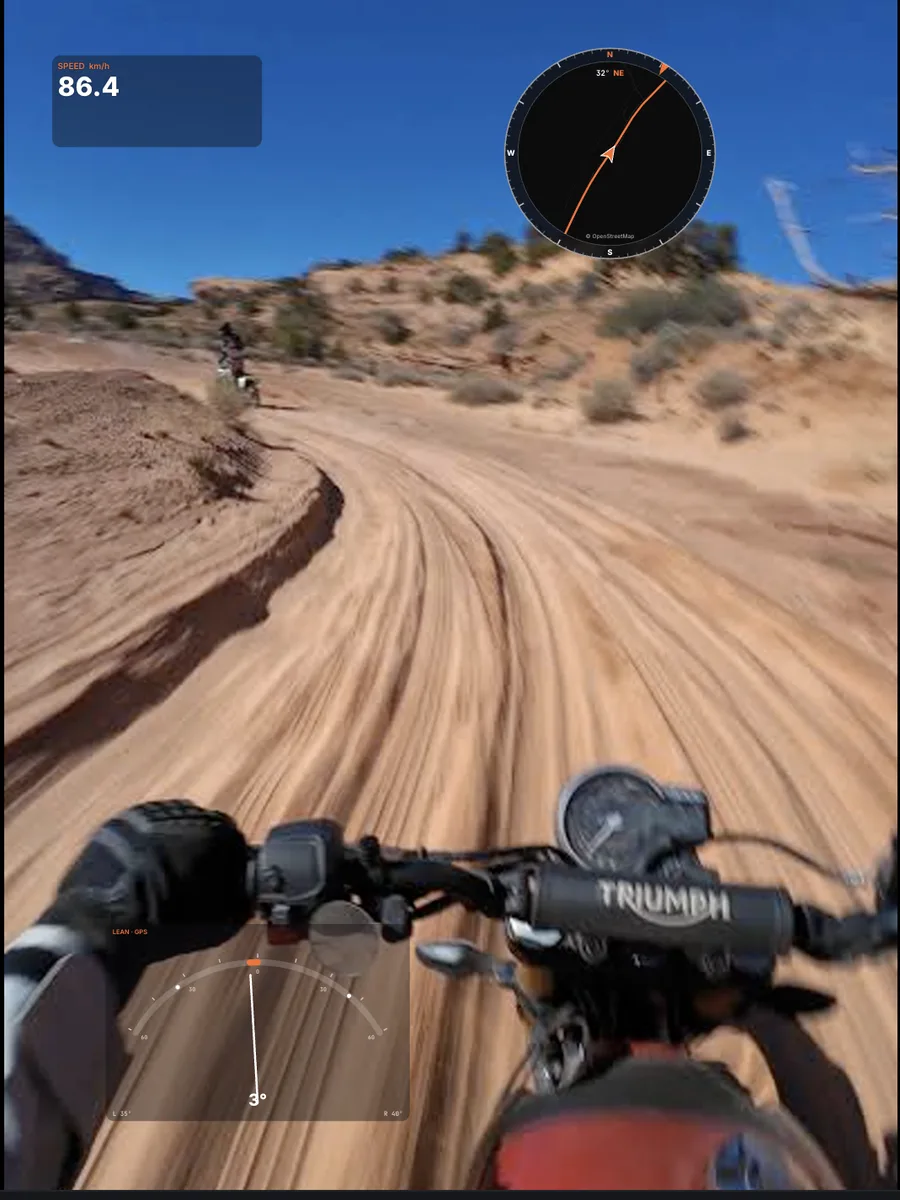
The formula
In a steady corner, the bike must lean so that gravity balances the centrifugal effect. For an idealised motorcycle with infinitely thin tyres:
tan(lean) = v² / (g × r) — with v the speed in m/s, r the corner radius in metres, g = 9.81 m/s².
Two consequences: lean grows with the square of speed (twice as fast in the same corner is far more than twice the lean), and it does not depend on the weight of the bike or the rider.
What it gives in practice
| Speed | Corner radius | Theoretical lean |
|---|---|---|
| 30 km/h | 15 m (hairpin) | ≈ 25° |
| 50 km/h | 50 m | ≈ 21° |
| 50 km/h | 30 m | ≈ 33° |
| 90 km/h | 100 m | ≈ 32° |
| 90 km/h | 60 m | ≈ 47° |
Calculated with the formula above. Real tyres have a width: the contact patch moves to the side when leaning, so the bike has to lean a little more than the theory. On the other hand, a rider hanging off the inside lets the bike itself lean less for the same corner.
Road, track, MotoGP: orders of magnitude
- On the road, most corners at legal speeds call for lean angles in the twenties or low thirties. Feeling “very leaned” at 30° is normal: it is already a lot.
- On track, with sport tyres at temperature and no oncoming traffic, experienced riders go well beyond 40°.
- In MotoGP, riders regularly exceed 60°, with tyres, bikes and riding technique designed for it.
The margin left on the road is what absorbs gravel, a damp patch or a corner that tightens.
How to measure your lean angle
- Dedicated apps and data loggers mounted rigidly on the bike measure roll with their sensors.
- From an action camera: if it is fixed to the bike, its gyroscope and accelerometer give the roll. If it is on your helmet or chest, they measure your head or body, not the bike.
- From the GPS: speed and the curvature of the trajectory give the lean from the formula above, whatever the camera mount. This measures the effective lean of the bike-rider pair.
Orbitrace offers both methods: from the GPS (any mount) or from the sensors (camera fixed to the bike). It shows the angle live on your video with your left and right records, and finds your biggest lean automatically. Like any consumer measurement, it is an estimate: perfect to compare rides, not a calibrated racing logger.